64° and Sunny
Image
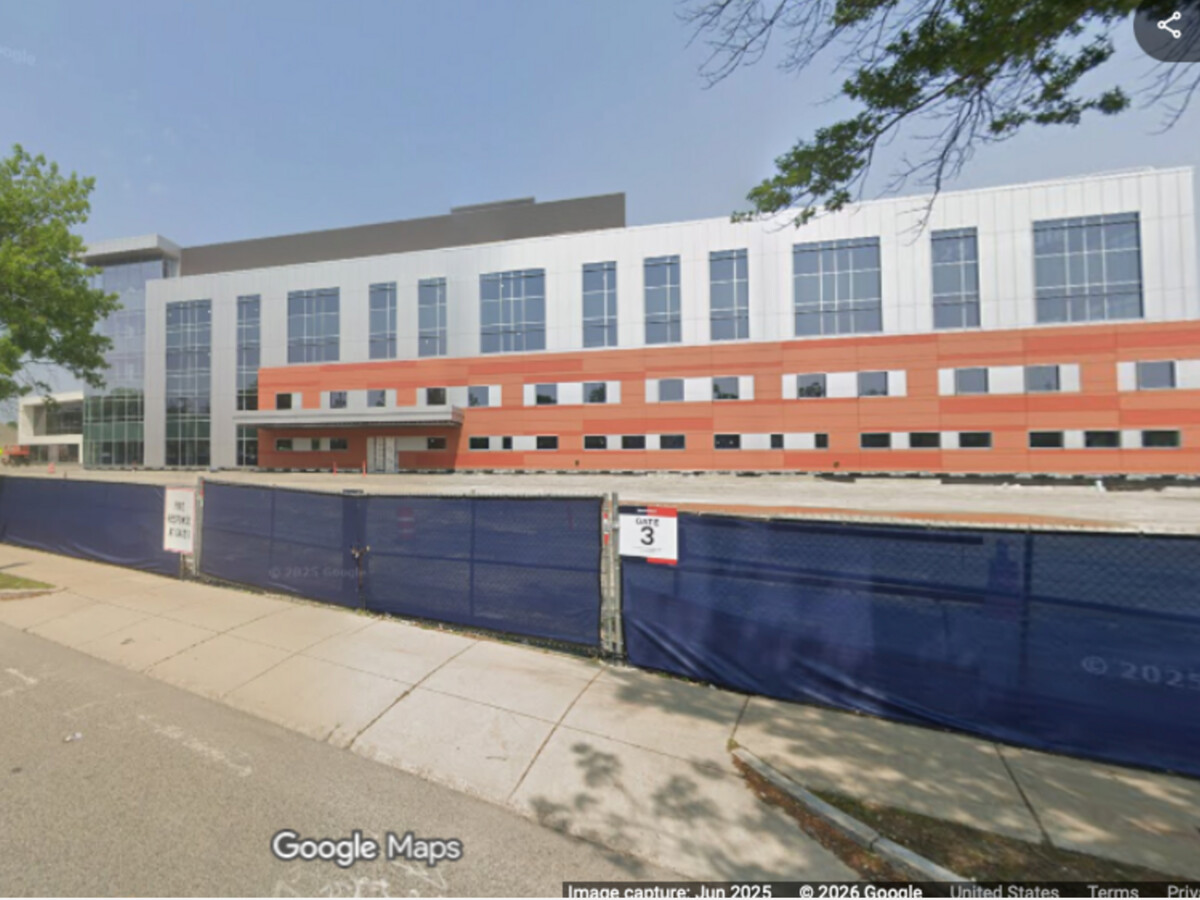
Image capture June 2025 from Google Maps. As it appeared last summer, pictured is the reconstructed outer shell of Norwood Hospital at 800 Washington Street in Norwood.



Six years after a catastrophic flood, Norwood Hospital remains closed. On June 22, the Norwood Hospital Task Force, led by Task Force Chair and Norwood General Manager Tony Mazzucco, issued an interim report supporting the return of 24-hour acute care services at the hospital’s site through acquisition by eminent domain by the state, or, if necessary, the Town of Norwood.
The task force is urging the Massachusetts Legislature to advance H.5192, legislation filed by state Senator Michael Rush and state Representative John Rogers, which would authorize the Commonwealth to acquire the property and facilitate its return to providing health care services under a qualified operator.
If eminent domain by the state fails to proceed, the task force is urging the Town of Norwood to consider eminent domain, in order to bring back 24-hour acute care services to the site which once served approximately 250,000 people.
"What happened to Norwood Hospital should concern every resident of Massachusetts," said Mr. Mazzucco. "This hospital did not fail. It was profitable. It served generations of families. It was lost to a natural disaster and then became trapped in a system that increasingly treats health care infrastructure as a financial asset rather than a public necessity."
Currently, the hospital’s foundation, structural frame, and building utilities have been completed. The interior is unfinished. At the time of the flood that forced Norwood Hospital’s closure, Steward Health Care was its operator. Steward began reconstruction in 2022, but then filed for Chapter 11 bankruptcy protection in 2024. As a result of the bankruptcy, control of the Norwood site passed to Medical Properties Trust (MPT), an Alabama-based real estate investment trust. The land underlying the hospital is owned by MPT.
"Across Massachusetts and around the country, private equity firms, real estate investment trusts and other financial interests have extracted enormous value from hospitals while communities are left to deal with the consequences," said Steve Costello, a member of the Norwood Hospital Task Force and president and chief executive officer of the Bank of Canton. "Norwood Hospital is one of the clearest examples of what happens when financial engineering takes priority over patient care and community health."
According to a statement by Mazzucco, MPT recently raised its asking price by 50% during negotiations with a local hospital operator.
“Corporate greed and private equity pillaging of our healthcare system in Massachusetts must come to an end,” said Mr. Mazzucco. "At some point, this conversation must stop being about real estate transactions and start being about public health," he said.
In addition to supporting H.5192, the task force is encouraging residents to sign the Finish Norwood Hospital petition, which has already collected more than 6,000 signatures.
The task force's interim report, titled, “Restoring Our Regional Hospital,” states that the impact of the hospital’s closure includes longer ambulance transport times and the loss of a catheterization laboratory. The lab was one of about two dozen in the state capable of performing a percutaneous coronary intervention, described in the report as the “definitive treatment for a major heart attack.” The task force says the closure has also resulted in the “redistribution of a quarter-million people’s demand onto a system with little room to absorb it.”
Beth Israel Deaconess Hospital-Needham has experienced the largest jump in occupancy since Norwood Hospital’s closure, rising from 65 percent occupancy in FY 2019 to 93 percent occupancy in FY 2023, according to the report. Newton-Wellesley Hospital comes in second, with occupancy rising from almost 56 percent to 78 percent for the same time period. Some residents also travel to Boston, Milton, and Brockton.
The report includes the experience of Norwood resident, Mike Connors, who suffered a stroke at home and was transported by ambulance past the closed Norwood Hospital to Beth Israel Deaconess Hospital-Needham, and from there, to Boston. He makes the point that in a case of a stroke, every minute is precious.
Patients who might have previously been treated in Norwood now have had to seek medical care elsewhere, and data included in the report show that ambulance transport times have increased from 2019 to 2024 for nine of 10 towns in the catchment area. Time to be transported to a hospital increased by as little as one minute from Westwood, Canton, and Wrentham and by as much as 13 minutes from Walpole.
The percentage of ambulance transports reaching a hospital in under 30 minutes also fell for nine of 10 towns during Norwood Hospital’s closure. Walpole experienced a 57.8 percentage-point drop from 67.8 percent in 2019 to 10 percent in 2024. Westwood experienced a 1.8 percentage-point decrease in the number of transports reaching a hospital in under 30 minutes, from 50. 1 percent to 48.3 percent.
Of all towns listed, Westwood is the only one that did not experience a decrease in the percentage of crews being back in service in under 45 minutes after an ambulance transport. It actually improved on that measure from 2019 to 2024. Across the categories measured above, though experiencing some negative impact from the hospital closure, Westwood stands out for appearing to be the least affected town. This may be due to Westwood's more central location relative to a number of other hospitals, compared to other towns in Norwood Hospital's catchment area.
“The towns closest to the former hospital – Norwood, Walpole, Dedham, Sharon – show the largest declines. The data reflects proximity to a hospital, and the towns that lost their nearest one lost the most,” says the report.
"The communities Norwood Hospital served lost their hospital and its acute care services to a natural disaster. A chain of corporate failures outside their control has compounded the consequences of this disaster and denied a region access to vitally necessary healthcare services," the report states.
"Today, a partially completed hospital sits vacant while hundreds of thousands of residents continue to live with the consequences," said Mr. Mazzucco.



Overcast, with a high of 64 and low of 46 degrees. Overcast in the morning, sunny in the afternoon, clear in the evening, overcast overnight.