Image
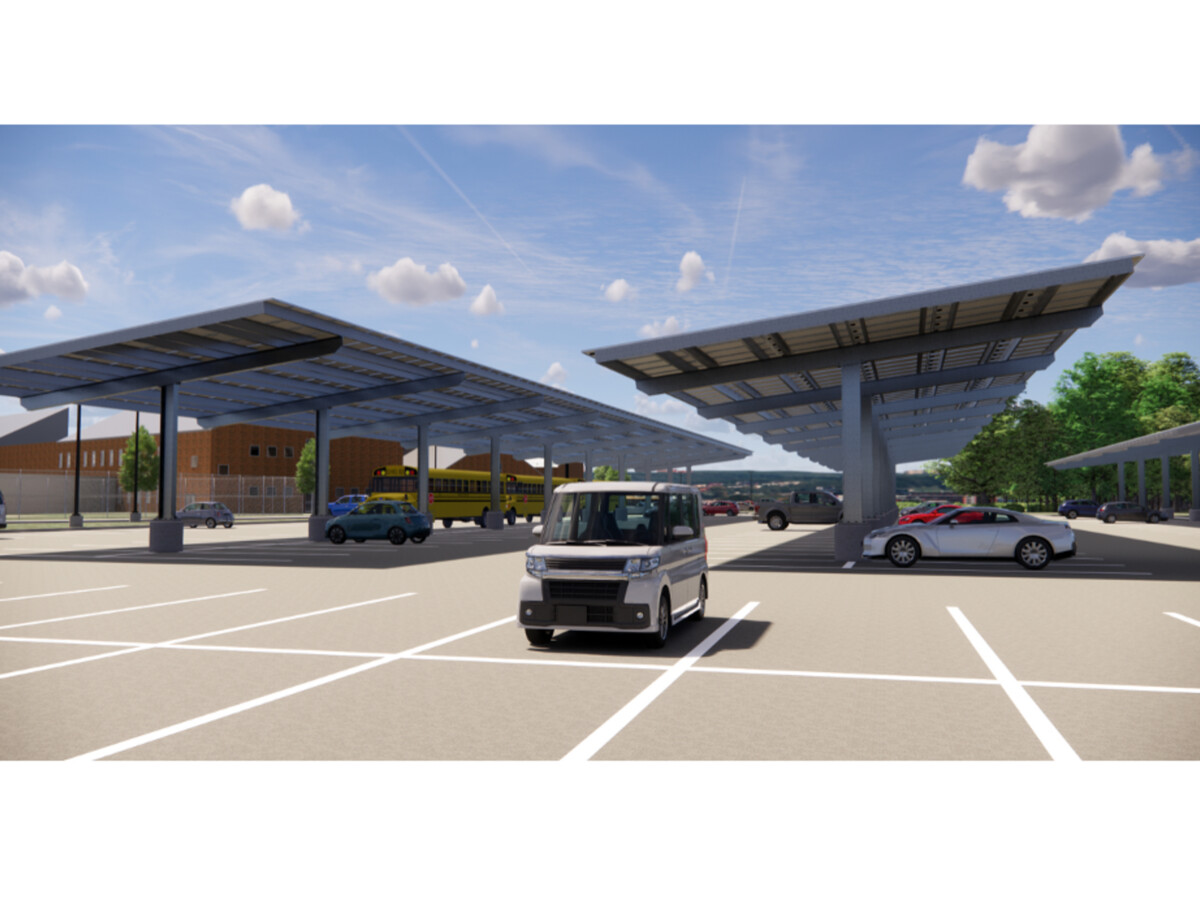
Image courtesy of Ameresco. The above is a rendering of what the completed solar array in the parking lot of Westwood High School will look like when school resumes at the end of August 2025.



The Town of Westwood will be generating about 80 percent of its energy from renewable energy, after the large solar canopy currently under construction at Westwood High School comes online this fall, says Westwood’s Energy Manager Thomas Philbin.
Solar panels will be delivered in late July or early August to the WHS parking lot, and the project should be complete and operational when school starts in late August, says Mr. Philbin.
The Westwood Public Schools are the town’s greatest electric consumer, says Mr. Philbin, so with the addition of the new solar array at the high school, along with the recently built solar array at Pine Hill Elementary School, the impact on the town’s electric profile is significant.
“We are proud to play our part in reducing the carbon footprint of the town,” said Superintendent of Schools Timothy Piwowar. “We are at a critical juncture in terms of protecting our environment. The school department is constantly looking for ways we can contribute positively to conservation efforts.”
The new WHS solar panels are expected to generate almost $30,000 in savings during its first year and $45,000 per year through 2045, according to town officials, with cost savings over the 20 year estimated life of the solar panels to total just under $716,000. This cost savings is due to the lower cost of obtaining electricity generated from the solar panels versus from Eversource supplied generation, and a fixed rate contract for the next two decades.
Ameresco will own the solar array at the high school through its expected service life of 20 years, and will sell electricity back to Westwood High School at a reduced, fixed rate during its time of ownership, after which the Town of Westwood will own the solar array.
The WHS solar canopy project will include features such as an ice melt and drainage system that directs water underground, LED lighting under the canopies, security cameras, and bicycle parking.
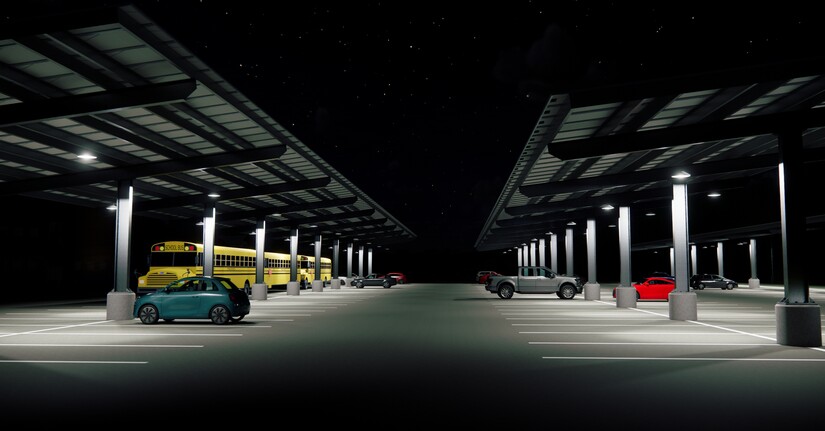 Image courtesy of Ameresco. LED lighting is planned for the solar canopy at Westwood High School, as shown in this rendering.
“There are some additional benefits that will also result from this project,’ said Westwood Energy Manager Thomas Philbin. “The canopies will replace the need for tents on Westwood Day. The need for snow plowing in winter will be greatly decreased and parked cars will be protected from sun and rain.”
While a snow-covered canopy will diminish the ability of the solar array to generate electricity, the high school is still connected to the grid. On snowy days and at any other time of year, the school will meet any electric demands beyond what the solar canopy can provide through Eversource, says Mr. Philbin.
Along with the solar array, two charging stations with four ports for electric vehicles will be installed in the portion of the WHS parking lot that is dedicated for faculty and public use. Mr. Philbin notes that the equipment and installation of the charging ports will be funded by grants through the state and Eversource. Costs can run in the neighborhood of $10,000 to $20,000 per port for equipment and $50,000 to $100,000 for construction and installation, he says.
The stations will be available to the public and school staff, and the public will be able to determine the availability of chargers if they subscribe to a network which will shows the location of unused chargers.
In spring of this year, the Town of Westwood also received an incentive of $5,054,655 from the federal government under the Inflation Reduction Act for the installation of 60 geothermal wells at the newly constructed Pine Hill Elementary School. The incentive award reduces that sum of borrowing funds needed by the Town of Westwood related to constructing the new school, and represents coverage of 30 percent of the geothermal system cost of $18 million. The ability of the town to take out a smaller loan for the cost of the new school’s construction results in a direct benefit to taxpayers, says Mr. Philbin.
In the geothermal system, water circulates through the ground’s isothermal layer at a constant temperature, and absorbs heat in cold periods and sheds heat in warms periods to efficiently cool and heat the school, respectively.
“The Pine Hill School incorporates sustainability in almost every aspect of its design,” said Mr. Philbin, of the school which has been awarded Gold level status by the U.S. Green Building Council. “It was an intentional process to help offset cost and to help the town reach our efficiency goals.” He noted that Pine Hills is among the most efficient schools in the state. “These efforts demonstrate the Town’s commitment to energy efficiency and projects that reduce costs,” he said. “Westwood hopes to be both a leader in the state and model for others in the efforts to minimize climate change effects.”
Securing the $5 million incentive for the geothermal system took almost two years of work by Mr. Philbin, town staff, and the town’s consultants. The incentive was suggested by the town’s consultant at Dore + Whittier, the firm which designed Pine Hill School and which is behind the currently proposed plans for a new Fire Station One. The application was filed in early September 2024, with payment expected by the end of that year, but a filing error by the Internal Revenue Service delayed the payment until May 30, 2025. The incentive payment of $4,880,889 was increased by $173,766 in interest for the delay, for the total payment to the town of $5,054,655.
Although Mr. Philbin notes that, “My nerves were shot,” regarding the suspense over whether the federal government would come through with the Inflation Reduction Act's $5 million incentive award to the Pine Hill School project, he continues to look for energy efficiency and cost savings for the town. “Some people want to retire, but I don’t ever want to retire,” says Mr. Philbin. “I want to do this as long as I can. I love Westwood,” he says of his 31 years in the town.
He notes that the “low hanging fruit” has been addressed already, and because Westwood has been so successful in obtaining grants thus far, he anticipates the size of future grants may be limited. But he will continue his cost saving efforts with the new fire station being planned, renovations performed in the schools, and lighting upgrades that may happen throughout town. Mr. Philbin points to the potential to “clean up” electric systems, such as the 11 year-old Westwood Public Library, where new, more efficient technology could replace older technology.
Thanks to Thomas Philbin, the Town of Westwood, and Ameresco for sharing their news with Westwood Minute.
Tom P is worth his weight in gold to the Town of Westwood, and to our kids and grandkids for what he’s done to reduce our collective carbon footprint. This high school canopy project has taken far longer to be built than I ever would’ve imagined when the idea first came up many years ago. Kudos to Tom for his dogged persistence.



Sunny, with a high of 57 and low of 35 degrees. Sunny in the morning, clear in the afternoon and evening,