47° and Clear
Image
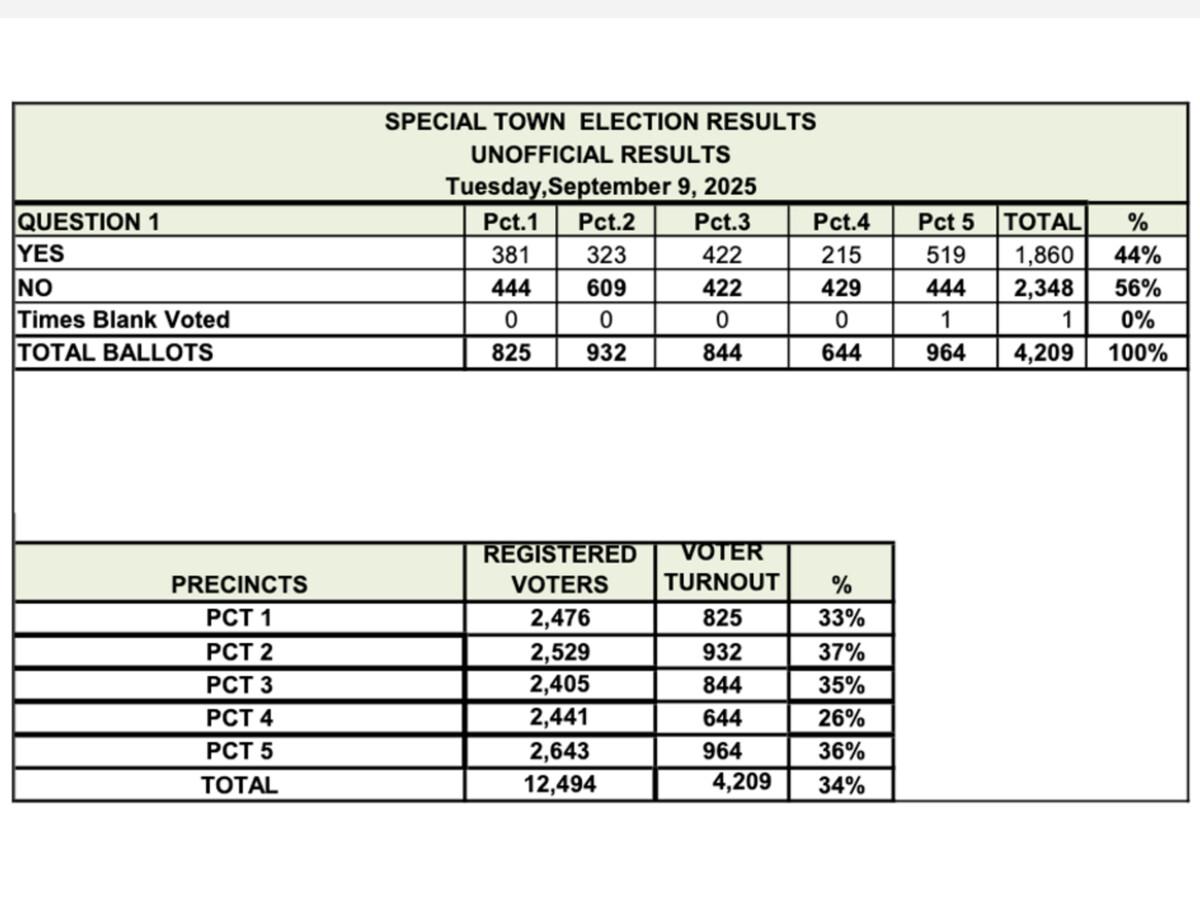
Image source: townhall.westwood.ma.us (September 9, 2025 - Special Town Election Unofficial Results). This chart shows how Westwood residents voted in the September 9, 2025 Special Election, in each precinct.



An unusually high number of voters turned out to participate in Westwood’s September 9th Special Election, with 4,209 voters, or 34% of total registered voters, making their opinions count on the question of whether to allow borrowing for construction of a new, $38.1 million Fire Station.
By comparison, in Westwood's two previous special elections, voter turnout was only 18% and 21%.
This week’s September 9th Special Election was a revote on the same question that town officials had posed to residents just three months earlier, on June 3rd.
In the June election, where the outcome was the same as in September, the voter turnout was 2,293 (18%) of 12,434 registered voters.
On October 26, 2021, Westwood held a Special Election on a question of borrowing to fund the design, construction, and equipping of a new elementary school. In that election, voter turnout was 2,483 (21%) of 11,864 registered voters.
The voter participation rates from the earlier June and October Special Elections were at about the same level as those that Westwood Minute Contributor John Aram found in the article, “Local Governance Study Suggests Limited Impact of Governing Structure on Voter Participation.”
The 34% participation rate on September 9th suggests that voters were especially motivated to participate. In the end, they delivered an outcome that rejected the recommendations of Select Board, Finance and Warrant Commission, Zoning Board of Appeals, and various other boards which approved the design and associated costs of a proposed, new Fire Station 1.
Voters' rejection in September of the funding mechanism necessary to raise $38.1 million for a planned, new fire station stands in stark contrast to residents’ approval four years ago of borrowing $84.6 million to build a new elementary school. In October 2021, voters overwhelmingly approved raising taxes for the new school as a debt exclusion from Proposition 2-1/2, with 73% voting in favor, and only 27% voting against the borrowing.
In the case of the construction of Westwood’s new elementary school, proponents announced that costs would be eligible for a sizable grant from Massachusetts School Building Authority (MSBA). MSBA could potentially award Westwood up to $18.2 million of approved project costs, said project planners.
In contrast, leading up to Special Election votes in both June and September this year, there appears to have been no comparable or concrete mitigation measure offered to residents to ease the effect of the tax increase from the proposed construction of a $38.1 million new fire station.
I hope the vote is a wake-up call for our town’s leadership, but I am not sure as I said the same thing after the same FS1 proposal was rejected in June. Voters are increasingly aware that their concerns, voiced at various meetings, are heard but rarely acted upon. As an occasional meeting attendee, I consistently leave feeling dismissed, as if elected and appointed officials believe they know better than the residents. This is not how democracy should work. People shouldn’t feel intimidated or excluded from participating in the process. The tone of arrogance from some officials is alienating voters and discouraging engagement.
The recent town meeting, where malfunctioning clickers forced residents to stand for their votes to be counted, was an embarrassment. In a town where a vocal group of self-righteous individuals criticizes dissenters, standing up to vote against the majority takes courage, especially when some of the self-righteous head online to intimidate those who have a different opinion than them. At the same town meeting, the moderator allowed a former resident to waste time with irrelevant comments about her outfit, while shutting down others with pertinent concerns. This lack of control undermines the process and alienates residents who want to contribute. If you want residents to engage in a healthy, productive way, make voting easy, fair, and comfortable. Technical failures and a hostile, condescending environment do not encourage participation.
It’s baffling that the same FS1 proposal, rejected by voters, was presented again without changes. Despite holding a so-called “listening session” over the summer, town officials ignored residents’ concerns and suggestions, pushing forward the identical plan. This dismisses the taxpayers’ voice, treating them as if they’re incapable of understanding the issues. Going forward, know the purpose of a listening session is to gather input not offer lip service. Residents are not naive, they know there are alternatives to relocating FS1 behind Starbucks. The assumption that you can outsmart the community is misguided. Our hardworking residents deserve a say in how their money is spent. Decisions should not rest solely with the planning board, finance committee, or a select few individuals—residents should work alongside you. Time and again, people attend meetings, offer suggestions, and are ignored.
The tone one member of the Select Board is setting is not resonating well with the community. They may be a good person, but there’s a perception problem. Their flippant responses to nervous residents who muster the courage to speak at meetings are disheartening. For example, their condescending remark to resident Ada Zhong online, stating, “I know English is a second language” and “let me familiarize you with an American phrase,” was deeply insulting. If more residents saw this, they might call for their resignation. Equally troubling was their shameless exploitation of the 9/11 tragedy to garner support for FS1, implying that opposing the project disrespects our nation’s heroes. Their statement, “We will mark the 24th anniversary of 9/11… how could any decent American have anything but respect for the finest and bravest we lost that day?” was manipulative and disgraceful. Equating a “no” vote on the FS1 project with a lack of respect for firefighters and EMTs was a shameful tactic. Voters rejected this project once, yet in an undemocratic move, the Select Board forced the same proposal back on the ballot just three months later, disregarding the clear will of the people.
Our firefighters and EMTs are true heroes, risking their lives daily with unwavering courage. They are the ones most harmed by the egos of certain town officials. It’s time to stop allowing a small group to dictate what’s best for our town. Residents may not speak as eloquently as some officials, but that doesn’t make their ideas less valuable. Many are hesitant to run for office or volunteer for boards because they fear personal attacks from a small faction. This does no good for our community. I hope more residents stay resilient despite harsh critics. Every voice in this town matters, even if it’s not the loudest.
Agnes R. does an excellent job in her comment of summarizing what went wrong in this process, and I would encourage everyone to think about what went right with the Pine Hill School process.
During the process, there were many who wanted more...one small example was that some wanted solar panels as part of the project, but the consistent message and clear sense of the community was that the project needed to be kept to only what was critical, or voters would not approve it. (The roof was made "solar ready" and then, outside of the funding in the override, Tom Philbin found $5 million in grant money so solar panels could be added!) There were opportunities to discuss the details, and instead of "driven by programmatic needs" being the answer, I feel there was more of a give-and-take and a sense of compromise. In the end, a consensus was achieved and demonstrated through strong support at a huge town meeting held on the football field, which led to endorsement in the special election.
The fire station process, while very "transparent," did not demonstrate the ability to adapt or adjust to residents' increasing concerns about size and cost. It stuck to the original scope of parameters from January 2024: 36K square feet at $35-40 million. That's good; the design fit what was originally authorized, but it failed to engage the larger community and adapt in a time of changing concerns and heightened economic insecurity. We absolutely need a fire station, and we need to do better over the coming months to make up for the time lost this summer.
I don't know what happened to the rest of my comment. It is possible I did not submit it correctly, but I had written like 3 paragraphs describing how the pine hilll school process was one of compromise and adjustment.
sorry, now it is visible again, immediately after I posted. I think maybe the website only displays the first sentence at first
Yes, depending on your desktop or mobile view, you may only see part of the comments. This can especially happen if you haven't clicked open the article completely (and if you are in the newsletter view). Also, you may need to refresh your view a couple of times before the new comment appears. Thanks for adding to the discussion.
I appreciate both of your perspectives and agree that the Pine Hill process was definitely well done.
I’ve come to learn that the design of a municipal safety building is much different from the design of a school building. When I really came to study this project after hearing claims that the building size was excessive, I learned that most of the increase in space is driven by the addition of a fifth bay. Due to required stretch codes, the bays will be larger. Other elements of the design are safety related e.g. ensuring that the fire station has proper decontamination zones. The existing fire station is built into a hill so that adds 8,000sf to the project. The existing FS1 is significantly undersized for current operations.
The cost of the building itself is $27.5 million. The total project cost is $38.1 million which includes moving the town’s (both town hall and school dept) infrastructure twice, temporary housing and project management costs required by law. I did ask what the cost would be of removing that fifth bay – needed to store apparatus (like the squad truck used for brush fires) that doesn’t fit at the existing FS1. It’s my understanding that it would save $2.5M. The reality is that we need that fifth bay.
I know I’ve said this repeatedly but haven’t received specific feedback re: what should be removed. I personally don’t see what could be removed to save any significant sum of money on the project to outweigh a fire station being too small and not meeting the needs from the day it opens. I’m admittedly struggling to see what should be different in a new design as the town wants to see a less expensive proposal. By way of clarification, I’m not on the working group but was on the FS1 Committee for the vote.
Immediately after the June vote, I don’t know why we could not have scheduled a town meeting for early September to amend the authorization by eliminating the 5th bay and reducing cost by 2.5M. Then, at that meeting (not on Facebook or whatever) people could argue that out and then resubmit to voters. That would have avoided this divisive summer by focusing on compromise vs doubling down, and it would have brought opponents to the table in good faith.
From June to September, the Select Board wasted three months failing to address firefighter safety concerns while burdening taxpayers with an expensive special election.
Holding repeated votes until getting the desired outcome is poor governance that dismisses our community's voice and wastes taxpayer dollars.
Our leaders should engage with Westwood residents and work toward solutions with genuine public support, not force through unwanted proposals.



Sunny, with a high of 58 and low of 40 degrees. Sunny in the morning, clear in the afternoon and evening,