Image




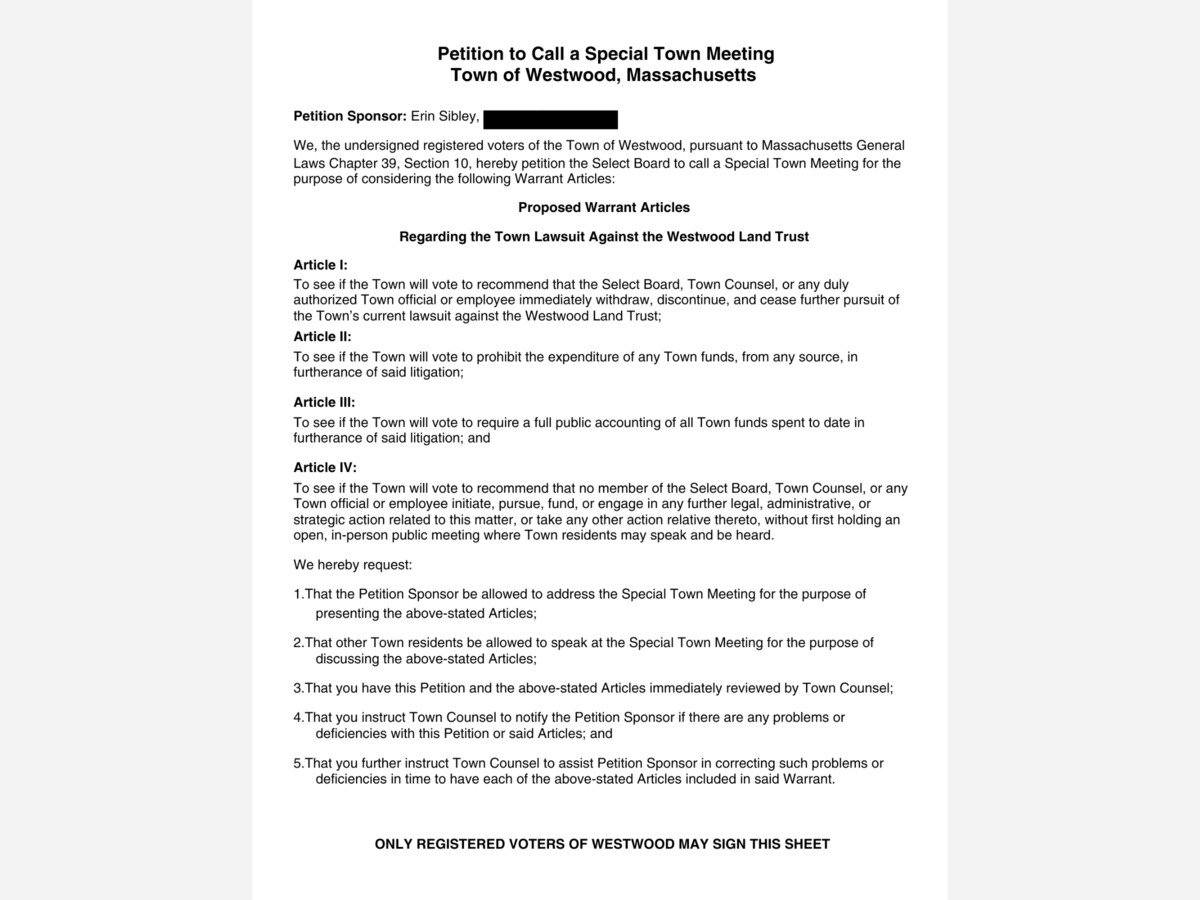
If the Board of Registrars certifies just 56% of the signatures collected on a petition that a group of organized Westwood residents recently circulated through all voting precincts in their town, it would trigger a state law (M.G.L. Ch. 39, Section 10) that requires Westwood Select Board to call a Special Town Meeting concerning Select Board’s decision to initiate litigation against Westwood Land Trust.
On Monday morning, December 22nd, Westwood resident Erin Sibley hand-delivered to Westwood Town Hall a petition representing the signatures of hundreds of Westwood residents. Only 200 signatures are needed to require Select Board to hold a Town Meeting. Ms. Sibley had hoped to get 250, just in case there were problems with certifying any signatories as registered voters.
In one week, she and a coalition of like-minded citizens far exceeded their goal of 250 signatures. They collected 356.
The petition has the potential to end a lawsuit commenced by Westwood Select Board against Westwood Land Trust (WLT), over an issue of agricultural use of conservation land in town. A copy of the petition which organizers circulated is appended to the bottom of this article.
WLT has refused to grant town officials agricultural use of a portion of undeveloped land for which WLT holds a conservation restriction. The land, about 8 acres located at 665 Clapboardtree Street, abuts The Bean Family Farm and is alternatively referred to in pleadings as “Prout Farm” or “Clapboardtree Meadow.” Prout Farm is comprised of about 28 acres at 665 Clapboardtree Street. It is owned by the town, but WLT holds a CR that limits use of the land for conservation purposes and WLT has authority to enforce the terms of the CR.
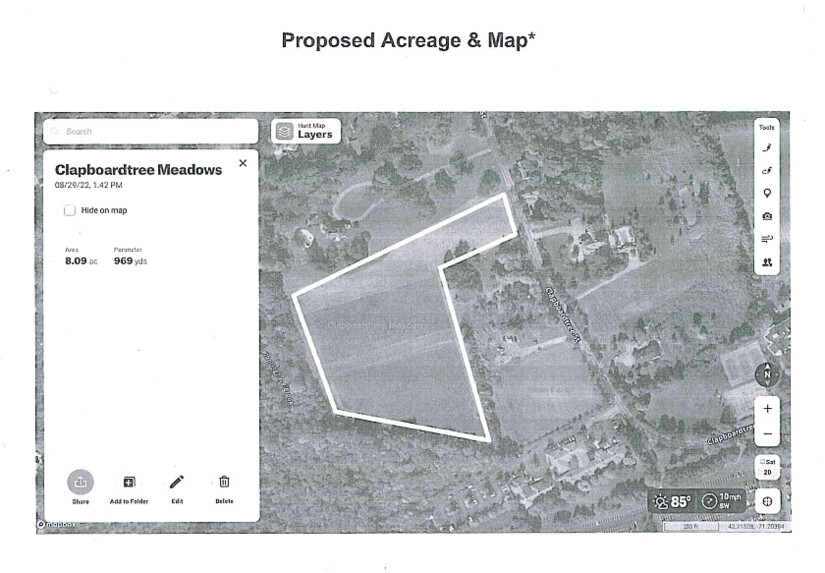 Source: Agricultural Use and Conservation Plan, Exhibit E of Town of Westwood's Complaint against Westwood Land Trust, Docket 2582CV00808. The graphic shows the portion of 665 Clapboardtree Street that The Bean Farm proposes to add to its farming operations.
A reading of the CR shows that its purpose is to limit the use of Prout Farm/Clapboardtree Meadow in order to preserve for public benefit the “unusual, unique, or outstanding qualities” of the land in a “predominantly natural or open condition.” Public benefits listed in the CR include preserving the town’s rural character, open space and associated views, wetlands, forests, wildlife, and conserving “prime agricultural soils” that are present on 10 acres of the property.
Ms. Sibley describes herself as an ordinary citizen, who until now has been an outsider to town politics. She says she has had no past history with WLT or any town board, and is not currently affiliated with either.
She first got wind of the controversy between the town and WLT after seeing signs posted in residents’ yards. Some signs urge residents to “Save The Bean Family Farm” on the one hand, while on the other hand, other signs counsel an opposing view, “Conservation, Not Litigation.”
On July 25, 2025, the Town of Westwood filed a civil suit against WLT, alleging in its complaint that “the Town is entitled to certain agricultural uses on the Prout Farm but the WLT has categorically prohibited all agricultural uses.”
The Town of Westwood states that it has a right to agricultural use of the farm under the CR. It says WLT was wrong to oppose its stated plans for agricultural use. The town asserts that WLT’s rejection relied on an assessment by EcoTerra Design & Consulting Group, but the town complains that WLT has refused to share the assessment with the town.
One letter from town counsel offered to mediate the dispute with WLT with the services of Anthony Antonellis, a former member of Select Board as well as a founding member of WLT. WLT declined to enter into mediation.
On July 16, 2024, Kenneth Berman, counsel for WLT wrote to Town Counsel Pat Ahearn, “Your position seemingly ignores the points we have made many times about the biodiversity and values of the meadow. It also ignores the donors’ and WLT’s wish to preserve the view scape of the meadow and keep the property as it was when the conservation restriction was created. Just because some holders of conservation restrictions at some other locations night choose to allow farming activities does not mean WLT must follow suite, whether at this location or any other. I hope you understand.”
In response, on August 29, 2024, Mr. Ahearn responded on behalf of the town, “It is important that your client understands that we believe your client is acting unreasonably not only in their decision but in withholding information on which your client alleges their decision is based on. As such, we retain all our rights in pursuing this opportunity but remain cautiously optimistic that a conflict can be avoided.”
After a succession of letters with the town prodding WLT to relent and WLT's refusal to do so, on October 8, 2024, Town Counsel Ahearn asked, “ . . . I would ask under what terms and conditions would your client allow the Town to exercise the agricultural exemption on a mere 8 acres of this property?”
On November 11, 2024, WLT Counsel Kenneth Berman responded that “it cannot consent to an agricultural use on any part of the restricted land.” Mr. Berman went on to direct the town to reasons stated in its earlier letters of April 3rd
and May 20th.
In those April and May letters, WLT explained its belief that the proposed farming would destroy the natural view with a commercial farming operation; destroy a biodiverse, mature meadow; threaten health of a stream and wetlands; introduce herbicides and pesticides; invite invasive species; destroy plant and animal habitat; and impose substantial cost to restoring the meadow after farming has ended. Mr. Berman noted that WLT had discussed the issue with experts in conservation, biologists, ornithologists, the CR donors, neighbors and residents. WLT’s interpretation of the CR is that the meadow should be preserved “as is” to protect the meadow’s view, he wrote.
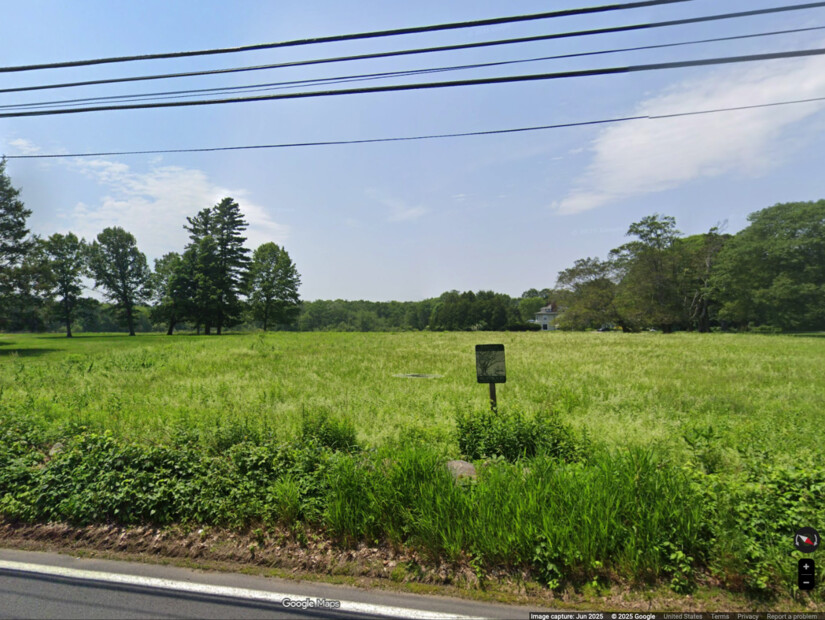 Source: Google Maps Image capture June 2025. Pictured is an open view and Westwood Land Trust's sign at Prout Farm/Clapboardtree Meadow at 665 Clapboardtree Street in Westwood, as viewed from the road.
The Town of Westwood now asks the Superior Court to declare that: (1) the agricultural uses being sought by the town are allowed under the CR; (2) the town has a right to conduct agricultural uses on Prout Farm; (3) WLT cannot decree a blanket prohibition against all agricultural uses of Prout Farm; and (4) the court should prevent WLT from rejecting agricultural uses on Prout Farm and the court should require WLF to allow them, as permitted by the CR.
On September 9, 2025, WLT filed its answer to the town’s complaint, along with a counterclaim. It asks that the suit be dismissed for failing to follow the CR’s requirements for requesting an agricultural use of the property, and that the town’s generalized request was insufficient to trigger a legal obligation by WLT to allow the use. Instead, WLT states that the town provided an Agricultural Use and Conservation Plan written by the owner of The Bean Family Farm. WLT says that The Bean Family Farm failed to give adequate assurances to WLT that the CR’s conservation interests would not be compromised.
According to WLT, converting Clapboardtree Meadow into cropland would “convert a stable, intact, highly functioning, broadly diverse, mature meadow into an agricultural one” that is dependent on human management. It states that the proposed agricultural use would reduce plant diversity and native animal habitat, jeopardize pollinators and species that prey on local pests, reduce beneficial organisms, and increase runoff.
The Bean family has weighed in on the litigation. In a letter to Westwood residents and Westwood Minute, Chuck Bean – father to Christopher Bean, who owns and operates The Bean Family Farm - recounted the history and intent of the CR. Chuck Bean recalls that his late father, Charles Bean, opposed development of Prout Farm when a 68 unit condominium project threatened to take over the location. Through Charles’s advocacy, Charles met neighbors Duncan and Ellen McFarland who purchased the land to put it into conservation. As Chuck Bean recalls, Charles requested the existing agricultural exception in the CR. It was intended that future Bean generations could farm the land, which is adjacent to the Bean Family Farm. Chuck Bean believes that WLT’s current interpretation of the CR goes against its plain language and original intent.
Supporters of The Bean Family Farm’s position point out that this same property that others refer to as Clapboardtree Meadow was, in fact, previously Prout Farm. Unless The Bean Family Farm can gain more usable land, the small farm will be unable to reach economies of scale to allow it to continue to survive. If The Bean Family Farm is unable to expand, it will have to close and sell its property to developers. Westwood will lose its last working farm, they say.
Opponents take a view like Ms. Sibley. They view the civil lawsuit by the town as hostile and unneighborly to WLT, a small nonprofit that is charged with protecting a land asset for the benefit of all Westwood residents. Some believe that the town is unnecessarily and wastefully engaging in a costly litigation for the benefit of a single, private entity - The Bean Family Farm – at the expense of taxpayers.
This litigation comes during a time when rising taxes are a hot button issue, a funding proposal for a new fire station recently has failed due to voters’ fiscal concerns, and needed construction or renovations for two schools and one or more municipal buildings are looming.
However, while Ms. Sibley may at first appear primarily to be an advocate of WLT, she says her primary objection is transparency.
“Most of us, people like me, had no idea this was going on. And now the town is using that fact that there’s a lawsuit filed to say it is a subject of litigation that they can’t speak about,” she says. It feels like yet another case of residents’ concerns being dismissed, she says.
Ms. Sibley remembers feeling a similar sense of dismissal when she attended Town Meeting in May to vote on funding for new construction for Fire Station 1. She voted yes in support of Select Board’s recommendation to go forward with funding the construction, she says. However, she was disturbed by the dismissive treatment that she said town officials gave to residents who dissented or questioned Select Board’s proposal.
She remembers a number of residents questioning why the town mailed out the warrant books so late, giving residents limited time to review voting issues. She recalled that not one town official apologized or answered the repeated question. Instead, she remembers a response being communicated along the lines of, “It’s too late to ask those questions now.”
“It’s not disrespectful to raise questions,” says Ms. Sibley.
For the past several Select Board meetings, residents have raised questions about the board’s decision to pursue litigation against WLT. They have implored members of the board to explain its motivations and have advocated for ending the lawsuit. They have been consistently met with silence during those public comment periods – a time at the start of each meeting which Select Board states it has a policy of only listening to public comments, but not responding.
Ms. Sibley provided public comment at the board’s December 8th meeting on the town's litigation against the land trust. She says she again experienced the familiar lack of feedback and feeling of being ignored by town officials. After that, Ms. Sibley says she and a number of other frustrated residents finally organized to look into what options they have as voters.
None of the members of Ms. Sibley’s newly organized group behind the petition are affiliated with WLT, she says. She says they have independently decided that a petition would be the way to get the answers they want.
According to Ms. Sibley, a small legal team drafted their petition, and at least 20 or so volunteers contacted friends and neighbors to gather signatures. Additionally, the group let the community know that it would be gathering voter signatures at Westwood’s Main Library for one and a half hours on Thursday evening, December 18th and again for two hours on Saturday, December 20th
On Monday morning, December 22nd, Ms. Sibley’s group had far exceeded the number of signatures they had hoped to achieve.
“Our group collected these signatures, in a somewhat scattered fashion, on very short notice, in ONE WEEK,” Ms. Sibley wrote in an update that she emailed to petition signatories. “I believe this incredible public response is indicative of a much higher level of community support for this meeting than even we were expecting. Residents have questions and we deserve answers,” she said.
“The purpose of this exercise is to provide all Westwood residents a public forum where proponents of both sides can speak and be heard,” wrote Ms. Sibley in a December 15th comment that she self-posted on the Westwood Minute platform, as she encouraged residents to sign the petition.
If just over half of the signatures that organizers gathered are certified, Select Board must hold a Special Town Meeting. Such a meeting will force town officials to hold a community discussion on the issue.
“I do not know how residents will vote, but I do believe we are entitled to meaningful public conversation about this controversy, whose cost and outcome will affect all of us,” says Ms. Sibley.
Updates: 12/27/2025 at 7:25 p.m.; 12/26/2025 at 9:31 p.m. A reference to certification being conducted by the state has been changed to certification by "the Board of Registrars."
Wow, thank you for that comprehensive explanation of this issue. public hearings before the suit was filed could have gone a long way toward avoiding this controversy and the distrust in our leaders it has sown.
Glad you found the article informative! Appreciate the positive feedback!
Congratulations, Erin, for not only raising these important issues regarding the town's lawsuit but taking action like the petition to force the town to give it's residents a chance to ask questions in a public forum. The overwhelming success of the petition augurs well for the special town meeting. This is a pure example of American democracy at work and brings to mind the words spoken by Abraham Lincoln in his Gettysburg Address: "that government of the people, by the people, for the people, shall not perish from the earth."
Eric Gutterson
Concerned Resident
Thank you for the comprehensive review of both issues!
Absolutely! Happy to help build an informed community.
An additional means of having our voices heard, and derailing such back-room types of decisions being made, is to force this Select Board out from behind their cameras and back into a Meeting Room.
We're long past due conducting Select Board, or any other Board meetings, virtually. Every other Town around us has long been back in meeting rooms. Regardless of the Governor extending the period of holding virtual meetings. Have them as hybrid at the very least. With questions being asked and answers being given. It's call accountability to the tax paying and voting residents of Westwood.

Thank you for this article! The simple rule of thumb for what is acceptable isONLY clean paper, cardboard, and empty bottles, cans, and rigid containers at least the size of a tennis ball.

Sunny, with a high of 66 and low of 41 degrees. Sunny in the morning, clear during the afternoon and evening,


No. We were presented with a cost of $38.1M. Not once, but twice. With the end result of 'No' both times.
How is $40M now, 4% less than $38.1?
And what's this out of nowhere number of $41.6M? In case someone forgot, again, we were presented with $38.1M.
Great catch, Brian, and sincere apologies for the confusion. You are correct that Westwood Minute's previous reporting focused on $38.1 million as the project cost voted down by residents in 2025.
Hi Darlene - Thanks for updating.