49° and Overcast
Image
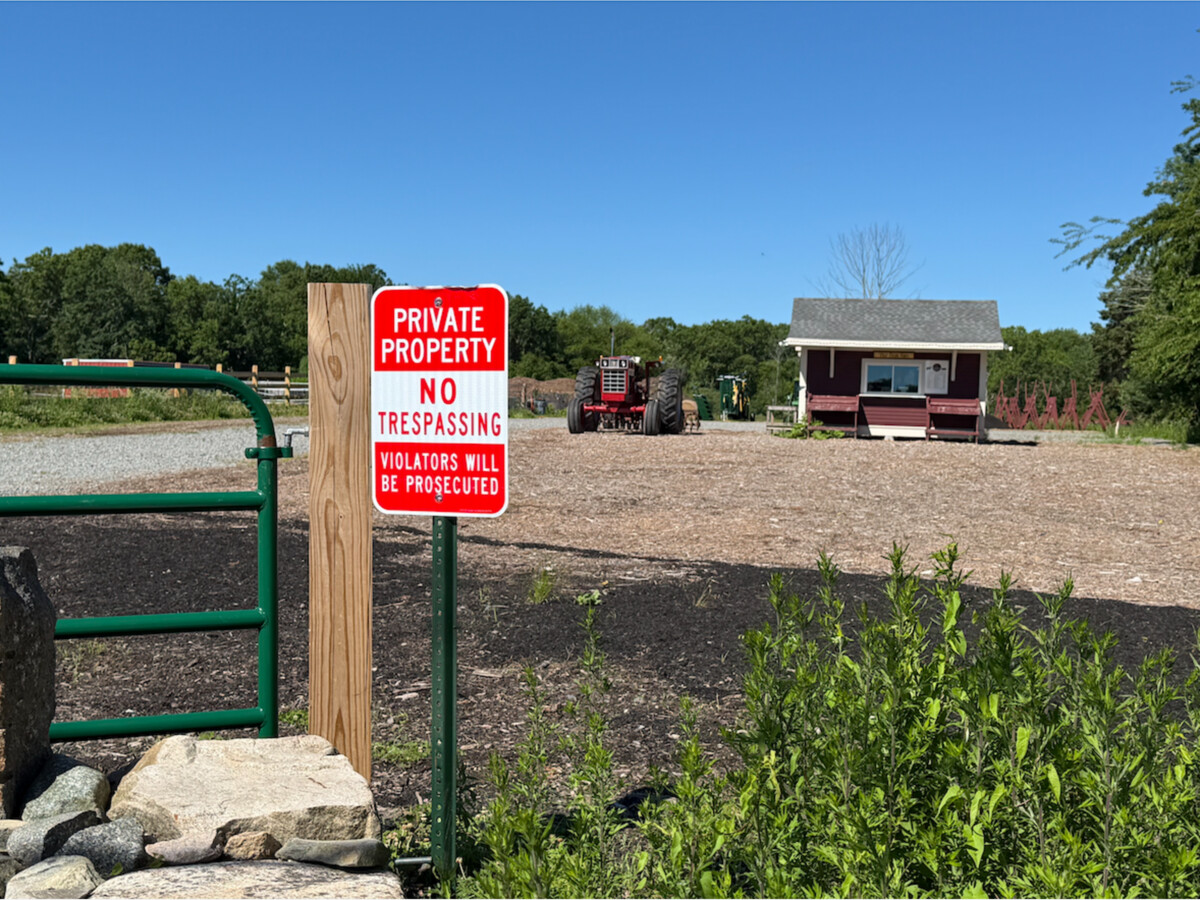
Photo courtesy of Andy Moore. Bean Farm has closed to the public after shutting down its vegetable operations following the decision in Town of Westwood vs. Westwood Land Trust.



As June comes to an end, so do the vegetable farming operations of the Bean Family Farm. The shutdown comes following the Superior Court’s May 7 rejection of the Town of Westwood’s request that the court compel Westwood Land Trust to allow the town to lease out eight of 28 acres of town-owned conservation land for farming, with the Bean Family Farm in mind as the likely lessee.
As of Friday, June 19, Chris Bean, operator of the Bean Family Farm on Clapboardtree Street, said that he had sold all but two pieces of his farming equipment. One of the remaining machines was under an oral agreement of sale. The other is his grandfather’s 1988 tractor, which he intends to keep.
Mr. Bean learned of the court’s adverse ruling in a group chat with family members.
“I was disappointed but not completely surprised. I was disheartened, but was already a little checked out because of the rancor around town and the rancor online,” he said.
The litigation had drawn passionate advocates on both sides. Supporters of the land trust voiced conservation concerns such as reduced plant diversity and native animal habitat on farmed land. They also criticized the town for what they described as a lack of transparency in its decision to sue a nonprofit, volunteer-run organization for what they said was the benefit of a private entity, especially at a time when taxpayers’ budgets are strained. Supporters of the town’s litigation argued that the land trust was unreasonable to deny the town’s request to allow farming on town-owned land. They said the town was asserting its rights as property owner, and they rallied in support of Westwood’s last remaining farm.
According to Chris Bean, additional acreage was essential for Bean Family Farm to meet the threshold requirement under state law that provides zoning protection to farmstands. The farm needed to produce at least 25% of its retail produce itself, which it has been unable to do given its present scale.
“Emotions have been stirring around in my family,” said Chuck Bean, who described his own feelings as angry, sad, and upset as he discussed his son’s difficult decision to shut down vegetable farming in Westwood. He called it the “end of an era.” Chuck’s father, Charles Bean, was a farmer who inspired Chris to follow in his grandfather’s footsteps by reviving the Bean Family Farm. Of Charles’s 13 grandchildren, only Chris has a serious interest in farming in a family that claims 14 generations of farmers, going back to 1652.
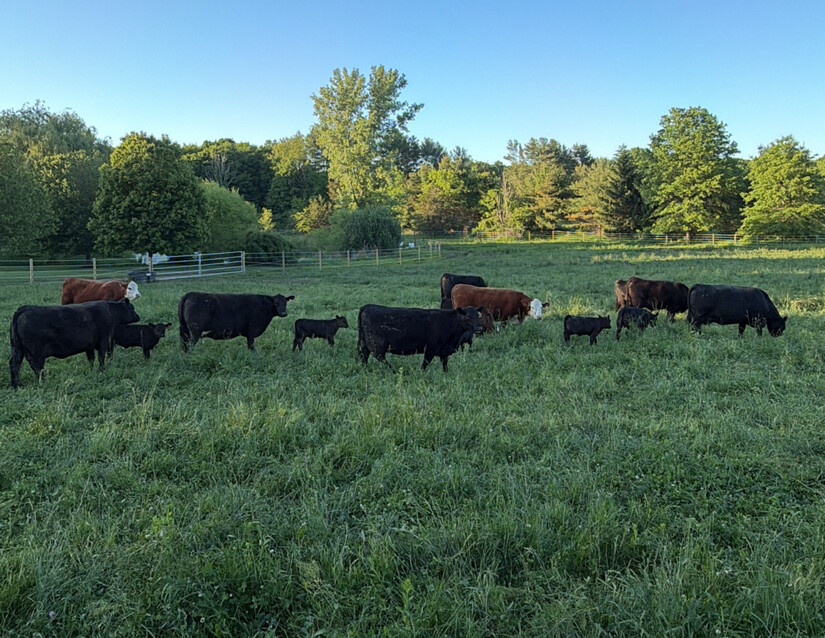 Photo courtesy of Chris Bean. While Bean Family Farm's vegetable operations have closed, Chris Bean continues his passion and hobby of breeding and raising Angus cows for a small beef business.
“My poor grandfather will roll over in his grave. Farming was his passion. I gave it a go,” said Mr. Bean.
On May 7, the Superior Court resolved the legal dispute that had divided the town. It determined that while Westwood Land Trust cannot apply a blanket prohibition to farming on the land at issue, the land trust did not violate the conservation restriction by rejecting the Town of Westwood’s request “to essentially allow a third-party to commercially farm the land.”
“The unambiguous purpose of the Conservation Restriction was to preserve the Premises for the public not for the benefit of a third-party commercial agricultural operation,” stated the court. The court criticized the idea of a third-party commercial operation deriving a private benefit from a public resource.
Mr. Bean said he is aware of accusations of his family being “greedy.” However, he disputes that characterization, saying the opposite is true. He pointed out that the land on which Bean Family Farm sits is owned by his father and his father’s three brothers. Mr. Bean describes all four families as making a “massive sacrifice” by allowing him to put their property to use as farmland, rent-free, instead of selling the land to developers.
“It’s not about money or power,” said Chuck Bean. “If so, we would have developed the property years ago. We have been supportive of the only grandchild of 13 who is interested in farming,” said Chuck. “That means something,” he said. “I have no idea why the whole town did not support the farm. A small faction grew into a much larger debate than we would have thought.”
Allowing farming on a small area of the conservation land would have been a positive result for the town and maintaining open space in Westwood, said Mr. Bean. He pointed to the benefits of having local produce and said that Xaverian Brothers students have been able to conduct soil sampling at the farm.
Mr. Bean recalled how, as a Xaverian high school student 10 years ago, he restarted the family farmstand using a 12-by-16-foot shed with one big window, bringing the Bean Family Farm back to life. He sold tomatoes and beans for $4.99 per pound and corn for $1 per ear. He noted that he was still charging the same price for those particular items two summers ago, while diesel fuel costs had doubled and other input costs had increased. Additional land could have brought more stability to the farm, he says, which has to compete with local supermarkets.
“I was very surprised not to see a massive uprising in the community to support the farm . . . and to keep the place in business,” says Mr. Bean. He views the debate in Westwood over farmland versus conservation land as an “outlier.”
“Many land trusts work with farmers and actively seek them out,” said Mr. Bean, describing how agriculture can be viewed as a means toward conservation. “It’s only eight acres. It is actively mowed every fall. The whole thing is kind of wild,” he said.
On behalf of the land trust, Vice President Abby Homilier provided a statement in response to the news of the shutdown of Bean Family Farm’s vegetable operations.
“The Westwood Land Trust's responsibility and focus has always been to uphold the conservation restriction placed on Clapboardtree Meadow more than 25 years ago, when the land was permanently protected and donated for the benefit of the community. We remain committed to honoring the intent of the conservation restriction and protecting the meadow,” she said.
She noted that the land trust has no information about the Bean Family Farm’s operations and therefore is unable to provide further comment.
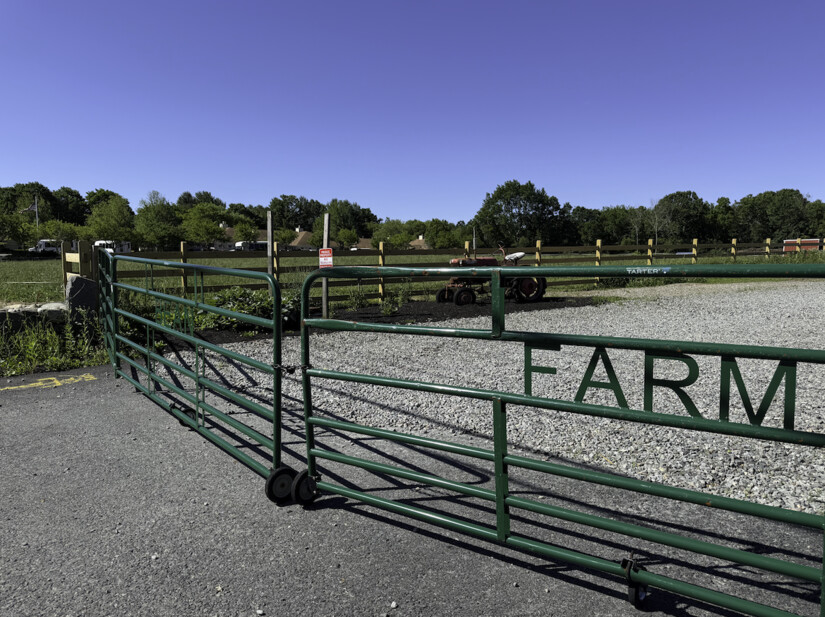 Photo courtesy of Andy Moore. The Bean Farm has closed its gates to the public until the time that it will sell seasonal wreaths and trees.
For now, Mr. Bean remains in Westwood to continue his part-time beef operation and passion project of breeding Angus cows and selling locally raised, premium beef. At the farm’s current size, it can support 10 cows. Given that scale, the farm need not be open to the public. Customers who want to purchase a quarter or half cow simply contact Mr. Bean personally.
“I’ve spent serious money investing in Angus genetics for the best marbling,” he says. “They’re all on fresh grass and in the pasture all summer long and on high-quality grain from a local provider,” he explains.
On whether he sees any path left open to farming in Westwood, Mr. Bean notes that “inevitably,” he will have to move to another town that he says is more friendly to farming. He is thankful for all the support he has received from customers during the decade he has pursued agriculture in Westwood, and is now looking for other opportunities to put his heritage and education to use. Properties in southern Massachusetts that are protected by an Agricultural Preservation Restriction look appealing. In the “distant future,” Bean Family Farm will likely be developed, says Mr. Bean.
In the meantime, the Bean Family Farm is temporarily closed to the public. “It’s too dangerous with livestock,” says Mr. Bean, while noting that he has erected a new gate to avoid children coming into contact with the animals. He will continue selling his beef by appointment and intends to open the farm to the public around Christmas, when he will sell trees and wreaths, as in years past.
Thanks to Chris Bean, Chuck Bean, Westwood Land Trust and Andy Moore for sharing their news and perspectives with Westwood Minute.
Updated 7/1/2026 at 9:44 a.m.
Such a poor business plan. Always was.
You're raising cattle on the land you could be utilizing for vegetables? Land that's more valuable (ROI) to growing vegetables vs. having insufficient land for raising enough cattle to make a go (profit) for your "passion". Not following.
Ignorant and pathetic response Sam Elliot. You know nothing about the business plans considered or the ROI on many agricultural contemplations.
Your Grandfather seemed to make a go of it. And for years.
What changed?
And he did so without a part of the conservation land.
Read the article
I am not sure why someone has chosen to label the Bean Family’s effort to farm land in Westwood as “a poor business plan”. To me, it is not clear if the writer is asserting that they should be growing vegetables on the land across the street from their farm stand or that they should be grazing cattle where they were growing vegetables. Perhaps the writer could explain what the “ROI” is on raising cattle vs. growing vegetables. Also, although 665 Clapboardtree Street has prime agricultural soils, does the writer know if the land being used to graze cattle across the street is suitable to grow vegetables?
Apparently, the over 100 farms that have closed in Massachusetts in the last decade must have also had poor business plans.
The bottom line is, if the Beans’ plan was to maximize their ROI, they certainly would not have chosen to farm land on Clapboardtree Street where a single-family lot is worth over a million dollars. The Bean family was willing to forego the enormous profit that could be made by developing the land and chose to allow Charlie Bean’s grandson to honor Charlie’s wishes and continue the family’s history of farming. Would he have succeeded in building a sustainable farming business? We will never know now, although Volante Farms in Needham, Allandale Farm in Brookline, and Wilson Farm in Lexington show it can be done.
Regardless, Westwood has now joined the many Massachusetts farming towns that no longer have a farm to support and enjoy. I understand that people have their own opinions about the value of the meadow at 665 Clapboardtree Street. However, there is no reasonable public access to it (no parking, no sidewalk to get to it, and it is extremely difficult to walk across because of the rough terrain). I drove by and counted the 10 seconds in which you can appreciate the view of the meadow, followed by the view of the Bean Farm. It was a pleasant rural view and a reminder of Westwood’s past as a farming community.
In my opinion, the Westwood Land Trust should consider whether their mission would be better served by attempting to maximize the land that is preserved in Westwood or simply asserting their right to exercise control of lands on which they hold Conservation Restrictions. In this case, they chose not to consider any compromise that would allow farming on a portion of 665 Clapboardtree Street. As a result (or at a minimum -- a contributory factor) the adjacent farm has closed and will now be developed. While the view of the meadow will remain, the view and open space provided by the farm will be forever gone.
Is this a win for the preservation of open land space in Westwood?
Good point of reference about the other farms. Unfortunately, we were never educated or had it explained to us just how much land was needed to make a go of it for the Beans. What if it turned out the other way around and that part of the conservation land had become available? Would it have been enough? That's what we were never told. That is, by being presented a business plan that we could all get our heads around.
Sam Elliot - I am not sure where the animus toward the Beans and need to criticize them is coming from (as far as I have been able to determine, there is no one named Sam Elliot in Westwood). Regardless, the statements that you are writing make no sense. First you say “Such a poor business plan. Always was.” Then in your follow-up you say the problem was that we were never given a business plan. If there was no business plan presented, how did you determine that the plan was poor?
As far as I am aware, no one asked the Beans to present a business plan that would show how the business would survive if they were granted permission to farm the conservation land. If they were asked, I am confident the Beans would have prepared and presented a plan to be evaluated. In point of fact, the Westwood Land Trust and their supporters were not concerned with the Bean Farm’s plan for survival. The WLT made it clear that their only concern was maintaining 665 Clapboardtree Street as a meadow.
Although the Beans were not asked to present a business plan, the WLT was asked to present the Cooperman Report that allegedly shows it is critical to maintain the property as a meadow. Perhaps someone can explain with the litigation concluded why the WLT is not making that document available for all to see and educate themselves regarding the value of a meadow vs. farming a piece of land.
Finally, you seem to want to insult the Beans by insinuating there is something amiss because their grandfather was able to succeed in farming the land without the benefit of access to the 665 Clapboardtree property. You ask “What changed?”
Obviously the entire economic environment of Massachusetts has changed; that is why hundreds of farms have closed and been developed – and so few have survived. In 1975 the average house in Westwood cost approximately $50,000; today the cost is well in excess of $1 million. Farming is a difficult, low margin business (on which we all depend to feed ourselves). With the economic pressure of incredible profits to be made by developing farmland to higher value uses (particularly in Eastern Massachusetts), it is easy to see why so few farms are left in this state.
Westwood has made their choice, and we no longer have a farm. Now we will all have to wait to see how the Beans choose to develop their land.
The least we can do is refrain from criticizing them for trying to maintain their family’s tradition of farming the land and resisting the temptation to reap the enormous profits that can be realized by developing their farm.
The Bean’s “save the family farm” & “farming is conservation” slogans are a total LIE. The Beans are sitting on land worth million$. They aren’t going to starve. Farming is NOt conservation if it means cutting down trees & removing wildlife habitat. Intentionally misleading, because they’re greedy.
Just a reminder to please keep Westwood Minute's Community Guidelines in mind when commenting. Criticisms of a person's decisions or public actions are not a reason for comment removal, but comments intended to personally attack another person are subject to removal.
Westwood Minute's guidelines include giving community members - including commenters and the subjects of comments - the benefit of a doubt, while seeking to allow for free speech and discussion as much as possible. However, personal attacks, profanity, self-serving promotions, and discriminatory or inflammatory remarks are subject to removal.
Commenters have the opportunity to modify their published comments. Simply click on the flag icon at the bottom right of your comment, select "Edit," make revisions, then click "Post Your Reply" to publish your revised comment.
Thanks for helping to support both respectful discussion and free speech on this platform.


Overcast, with a high of 62 and low of 46 degrees. Overcast during the morning,


Thank you for this article! The simple rule of thumb for what is acceptable isONLY clean paper, cardboard, and empty bottles, cans, and rigid containers at least the size of a tennis ball.

No. We were presented with a cost of $38.1M. Not once, but twice. With the end result of 'No' both times.
How is $40M now, 4% less than $38.1?
And what's this out of nowhere number of $41.6M? In case someone forgot, again, we were presented with $38.1M.
Great catch, Brian, and sincere apologies for the confusion. You are correct that Westwood Minute's previous reporting focused on $38.1 million as the project cost voted down by residents in 2025.
Hi Darlene - Thanks for updating.