Image
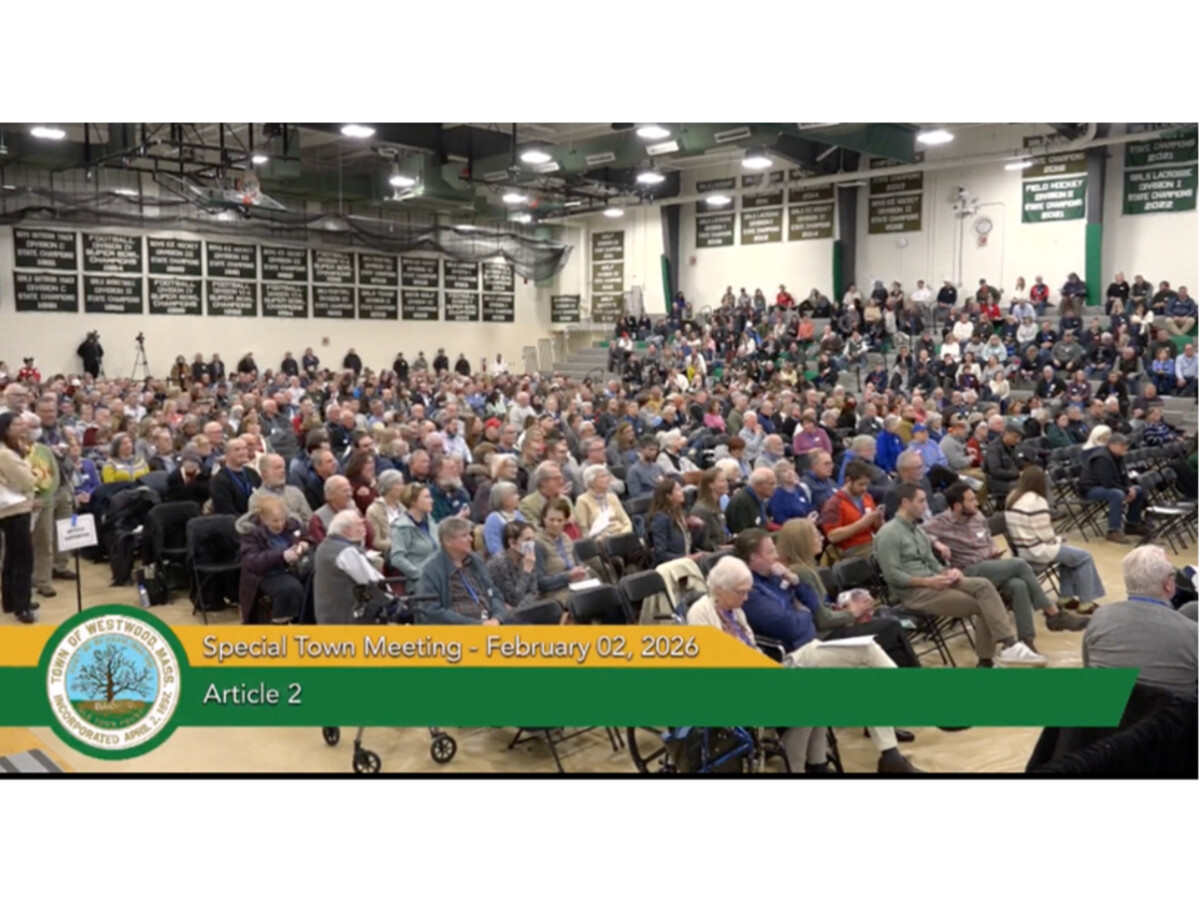
A majority of the well over 700 registered voters at Westwood’s Special Town Meeting held in the Westwood High School gymnasium on Monday, February 2nd, voted to urge Westwood Select Board to end its lawsuit on behalf of the town against Westwood Land Trust (WLT). In the lawsuit, the town is asking a court to require WLT to allow approximately eight acres of a 28-acre conservation area to be put to agricultural use under a conservation restriction (CR) held by the land trust.
At the Special Town Meeting occasioned by a successful citizen petition to call the meeting, citizens braved temperatures that fell below 20 degrees on a Monday evening to ensure their opinions were heard by Westwood's Select Board, in what Town Counsel Pat Ahearn has described - and petitioners have agreed - is a non-binding vote.
Across the board, a majority of voters approved each of the following four articles under consideration. The following is a paraphrased summary of each article and resulting vote. The exact text of each article is attached below this post.
In reaching a vote on the substantive merits of each Article, voters overcame the procedural hurdle of a motion by Westwood’s Finance and Warrant Commission for indefinite postponement of each article. A majority of voters rejected FinCom’s recommendations, which would have rendered each article “dead,” as explained by Moderator James O'Sullivan at the meeting’s outset.
As described by the sponsoring petitioner Erin Sibley as she introduced the articles, votes in support of the four articles would represent a demand that elected town officials take note of residents' desire for transparency on how they make decisions on residents' behalf.
Select Board member Marianne LeBlanc Cummings provided Select Board's view of the issues. She described the board's multiple attempts at dialogue with Westwood Land Trust and meetings in Executive Session, and characterized the decision to sue WLT as a last resort to protect the town’s property interest in the conservation land. She noted that legal expenses on the litigation are $15,300 to date of the Special Town Meeting, and urged residents to engage in constructive dialogue by putting "sides aside" to pursue common ground.
Updated 2/2/2026 at 11:52 p.m.
337 people showed up on a cold February night to vote against a non-binding resolution.
Yes, they did.
And this attendance and participation demonstrates how strongly folks on both sides of this issue feel about it, and how a majority of voters want the Select Board to withdraw from the lawsuit. It was a far larger turnout than in annual town meetings.
Props to everyone who pulled on their boots and went out into the cold night. Props to everyone who convinced friends and family to participate.
Thanks to our town clerk who made everything move smoothly. Thanks to the people who checked in voters. And to the Westwood Media Center for recording. Thanks to all who spoke. Thanks to those with limited mobility who came using canes and walkers.
Thanks to the young and fit who secured babysitters for their kids and came. Thanks to the many for whom this was their first Town Meeting.
Thanks to the police officers and firefighters on duty at the high school. Thanks to the Town Moderator. Thanks to the town employees who sat in the Visitors section. Thanks to our new town administrator on his first day on the job.
To suggest this was all a huge waste of time is a misreading of the situation.
It is false to assume a large majority of voters want the Select Board to withdraw. You can only say that the majority who showed up wanted to say that. According to Google AI, the average turnout at annual town meetings is 3.9% from 2018-2025, this was 4.6%.
You do realize this argument could be made in the other direction…there could be more voters who are looking to have the law suite dropped that did not show up either. All we can go by are the people who showed up to vote last night. And that statement was quite clear.
Yes of course, we don't know what the breakdown of support is for the lawsuit in the town is, I wasn't claiming anything. But the side that brings a Special Town Meeting has more incentive to show up than those who oppose it. It would have been nice to win the vote, but it was broadcast beforehand that the outcome doesn't matter. For example the FS1 vote; whether you wanted that tax overide (appropriations which is a valid Legistaive function) you needed to show up . It wasn't a suggestion to the Executive branch. Both sides had skin in the game.
So i see it a little differently, while everyone is focused on it not be a binding vote, i would think the select board should see that there is a group of residents that do not feel they are being listened to. To have the Select Board and the Moderator say they don’t care what the vote is because it is non binding makes it seem that the voice of the voters doesn’t matter and they will do what they want anyway. That is not the democratic process and seems downright rude and dismissive of the voters. Things are not going to get better in town until there is recognition of the different perspectives and people feel heard. You can’t win them all but everyone in town deserves to feel they are represented.
First Cheryl, thank you for taking the time to engage with me in a civil discussion and it is readily apparent your tone is positive, which isn't always the case on the internet.
If I'm understanding what you're saying correctly, you seem to lean a little more to the Greek democratic process where everything is up to a majority vote. For better or for worse our American democratic process breaks up power into the Executive, Legislative and Judicial branches. We elected the current Select Board, they make a compelling case they are acting in the Town's best interests regarding property rights. If the majority feels they are acting outside of the Town's best interests then they will be voted out.
Fascinating theory, that Town Meeting votes only count if enough hypothetical, couch-based voters might have shown up in an alternate universe. The people in the room aren’t a “sample,” they are the electorate at that moment. You don’t get to nullify an actual vote by speculating about the feelings of people who stayed home.
"You can only say that the majority who showed up wanted to say that." (the Select Board to withdraw ) Should one then assume that those who did not show up wanted the Select Board to go forward?
It is rather interesting that we were told that the town was left with only one option - to sue, when the Westwood Land Trust rejected using the Conservation Land for farming. Of course, the most obvious action the Select Board should have done was drop their insistence on using the land for farming when they were told, "no."
You’re still not understanding the situation. The Towns preference is to conduct agriculture activities and the WLT preference is to maintain a meadow. These cannot be unreasonably denied per the CR. By denying agricultural activities without giving a reason means the WLT is in effect taken ownership decisions away from the Town. It’s about property rights.
Did you know that the MacFarlands had also established another CR across the street? Instead of donating that piece of land to the town, it was sold to the Beans. That CR has a primary purpose of agriculture. It’s interesting to read it to understand the differences and understand more about the exceptions.
No where do you find these CRs?
You can search 682 Clapboardtree on the Norfolk registry of deeds.
Thank you. I agree it is certainly more permissive of farming, permitting cattle and allowing fencing to be built. But I also see a striking number of similarities, especially in the Purpose section.
"The "Towns " preference is to conduct agriculture activities"?
That begs the question, what is the definition of "town"? "Generally a densely populated area", a population of tax paying citizens. The WLT is there to maintain, protect and conserve a av gift to the citizens of the town. What is there to not understand?
The land is public property owned by the Town of Westwood. Agriculture activities are in limited circumstances allowed as a conservation measure. Farming can be conservation. The CR does not permit building a henhouse, or even bee colonies. It lists specific actions that would allow an exemption for growing vegetables.
The Town’s preferred method of conservation is farming. The WLT prefers maintaining a meadow. As the owner of the land, the Town is the one whose preference matters.
LOL! "Property rights."
Exactly. And it’s great that it sounds like they are coming to an agreement but the Land Trust was also never obligated to compromise.
I would suggest reading the WLT counter claims. They list 4 relevant cases and if you read them you might come around to a different conclusion. They center around Donor Intent and interpretation of whether a specific activity is appropriate. This is a situation of the Donor trying to exert a preference.
The CR says the Town can do A,B or C. The Town wants C. The WLT wants A. But they are claiming that what the Town is trying to do actually isn’t C, despite the clear language in Purpose 5 and Section III9. By saying C isn’t C then they can justify their actions. If they were to come out and say they simply prefer A to C then it would be very obvious to everyone what they were doing.
Select board meets tonight at 6pm: https://www.townhall.westwood.ma.us/Home/Components/Calendar/Event/4750…
this town meeting is not on the agenda but it will be interesting to see if there is any discussion
To be honest, if the Beans think that plowing up Conservation land is going to save their business, I think, they have another thing coming. What a bad business decision.
"Plowing" is one of the permitted exceptions in the CR, Section B.9.c. Agriculture is conservation.
Agree. Is the 8 acres they want going to save the business? Have they run the numbers? To be truthful, this was a bad business decision from the get-go. They may be great at farming and agriculture, but to be successful, there needs to be a business acumen applied here. Seems that wasn't the case. Unless, this was undertaken with the 'gamble' that they could acquire the additional land eventually.
And if this 8 acres doesn't provide profitability (at the publics expense because this would be public land for private use), will they be looking for another 8 acres. Once they're in, will this set a precedent for a continuation of eating up the remainder of the conservation land?
Those who are for the opening up of the conservation area to farming need to question the Beans and have them show us that this endeavor is worth the price of cutting into the conservation area against what the conservation area's value is to the environment.
Hi Brian, neither side has claimed that the Bean farm is "eating up" conservation land. The CR specifically mentions 10 acres. There is no other land that can be farmed per the CR.